






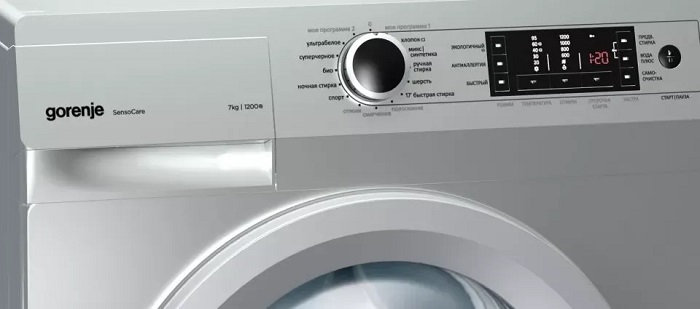
Gorenje washing machines are equipped with a self-diagnostic system that reports malfunctions via error codes on the display or through specific indicator lights. Understanding these signals Gorenje E03 code helps to quickly identify the source of a problem—ranging from issues with water intake or drainage to door-lock failures or electronic glitches—and determine the appropriate course of action to resolve it.
In this article, we will examine the most common error codes Gorenje E04, their underlying causes, and practical steps for troubleshooting—including what you can safely check yourself versus when it is best to contact a service professional. We will also take a specific look at the “E41” error, helping you get your appliance back up and running quickly while preventing the issue from recurring.
Decoding Gorenje Error Codes by Component Group: What Each Display Signal Means
It is most efficient to interpret these signals by “component group”; this allows you to narrow down the cause more quickly and determine which troubleshooting steps are safe to take. Listed below are typical error categories and what they generally signify in practice—ranging from simple issues, such as a closed water tap, to malfunctions involving the heating element (thermostat/heater), the tachogenerator, or the control board.
Errors by Component: Water, Heating, Drive System, Sensors, and Electronics
The water intake system (often indicated by codes such as E2, E3, Gorenje E41 error or similar, depending on the model series) typically signals that the tub has failed to reach the required water level within a set amount of time. In terms of specific components, this could mean that the water tap is closed, water pressure is too low, the inlet valve filter is clogged, the inlet hose is kinked or twisted, the inlet valve itself is faulty, or the water level sensor (pressure switch) is failing to detect the rising water level. If an error appears immediately after starting a cycle, it is logical to first check the water supply and the inlet valve.
…if the issue occurs after partial water intake, the problem likely lies with the pressure switch, its connecting tube, or the associated electrical contacts.
Draining and leak-detection issues (often indicated by codes such as E6, E7, or similar) suggest that the machine is unable to drain water or has detected a condition resembling a leak or “siphoning” (unintended draining). Potential causes include: a blockage in the pump filter, the tub-to-pump hose, the drain hose, or the household plumbing/sewer line; a jammed or worn-out pump impeller; air intake (suction) causing unstable pump operation; or an incorrect drain hose installation height, which leads to siphoning. If the error code is accompanied by a “gurgling” sound and water drains out on its own, the issue is usually related to the connection to the plumbing/sewer system; if the pump can be heard humming but the water does not drain, the cause is typically a blockage or a faulty pump.
Water heating issues (often indicated by codes such as E5, E9, or similar) mean that the controller has failed to detect the expected rise in temperature or has received an invalid signal from the temperature sensor. The root cause generally falls into one of three categories: the heating element (TЭН) is not heating (it may have burned out or developed a short circuit to the appliance chassis); the temperature sensor (NTC) or its wiring is providing incorrect readings; or the control module is failing to activate the heating function due to a faulty relay, triac, or internal safety logic. If the water remains cold regardless of the program selected and an error code appears after some time, the heating element and the NTC sensor are the components most likely to require inspection.
If an error code appears abruptly and the temperature reading is erratic, the sensor or its electrical contacts are the most likely culprits.
Drum drive and rotation issues (typically motor-related errors such as E1, E4, or similar) indicate that the controller is unable to start the motor, maintain the correct rotational speed, or properly manage acceleration and deceleration during the spin cycle. Potential causes include worn-out motor brushes (in the case of a universal/commutator motor), a loose or stretched drive belt, a faulty tachogenerator (speed sensor) or its associated magnet and wiring, a jammed drum or damaged bearings, or a failure in the power section of the control board (such as a faulty triac or motor driver). If the drum attempts to move but then stops, the issue often lies with the brushes or the tachogenerator; if the motor remains completely unresponsive, the problem likely stems from the power supply, the control board, or safety interlocks.
Door and door-lock issues (often indicated by codes like E0, E8, or similar) mean that the door-locking mechanism (DLM) has failed to confirm that the door is closed, or that the lock has failed to disengage once the cycle is complete. Possible causes include a door that is not closed securely, a worn-out door latch or hinge, a faulty DLM, burnt electrical contacts, or a situation where the controller cannot complete the cycle because water remains in the tub (in which case the door-related error may be a secondary symptom). If the error appears immediately upon starting the cycle, the issue usually lies with the DLM or the door mechanism itself; if it occurs at the end of the cycle, one should first rule out any drainage problems.
Level sensors, as well as issues related to excessive foaming or overflow (often indicated by codes pointing to the pressure switch, an overflow condition, or an “unstable water level”), signify that the detected water level does not match the expected level—whether it is too high, too low, or the signal itself is fluctuating.
Possible causes include: a clogged pressure switch tube, a breach in the air chamber’s seal, a faulty level sensor, or an excess of foam in the tub (due to unsuitable detergent or an overdose), which interferes with the proper operation of the level sensors and the drainage system. If the error code is accompanied by excessive foam, the first step is to address the detergent issue; if there is no foam, the pressure switch and its associated tubing should be checked.
Electronic and communication issues (involving the control module, memory, or sensor connectivity) indicate that the control board is receiving incorrect signals, detecting an open circuit, experiencing a “freeze,” or encountering a self-diagnostic failure. The diagnostic logic follows this sequence: first, rule out external factors (such as power fluctuations, oxidized connectors, or moisture ingress); next, check for damaged wiring harnesses; and only then consider a potential fault in the control board itself the circuit board (traces, power supply components, power switches). If an error code appears following a voltage surge, or when the unit heats up or vibrates, the issue often lies with the module’s electrical contacts or power supply.
Interpreting display signals for diagnostics
It is helpful to “read” an error code within its specific context: at what stage of the program it appeared (water intake, washing with heating, draining, or spinning); what sounds are audible (e.g., the pump, motor, or valve running); whether there is water in the tub; and the status of the door. Linking the error to a particular stage helps distinguish the root cause from a secondary symptom (for instance, a “door won’t open” error is often a consequence of a drainage issue).
- Errors occurring at the start usually relate to components required to initiate a cycle: the door/door lock mechanism (DLM), water intake, basic sensors, or the circuit board power supply.
- Errors appearing 10–20 minutes into a cycle often point to heating-related issues: the heating element (TЭН), the NTC temperature sensor, a relay or power switch, or, indirectly, an incorrect water level.
- Errors during the spin cycle are typically linked to the drive system or speed control: worn motor brushes, a faulty drive belt, a tachogenerator issue, or an imbalance/mechanical jam.
- Errors at the end of a cycle often point to problems with the drainage system/pump, or issues preventing the door from unlocking.
When decoding these signals, keep in mind that while alphanumeric codes (E1, E2, etc.) may vary across different Gorenje product lines, the way they are grouped by component remains consistent. Therefore, consider the display signal a “directional marker”—it tells you which component to check first, ensuring that troubleshooting is both efficient and safe.