






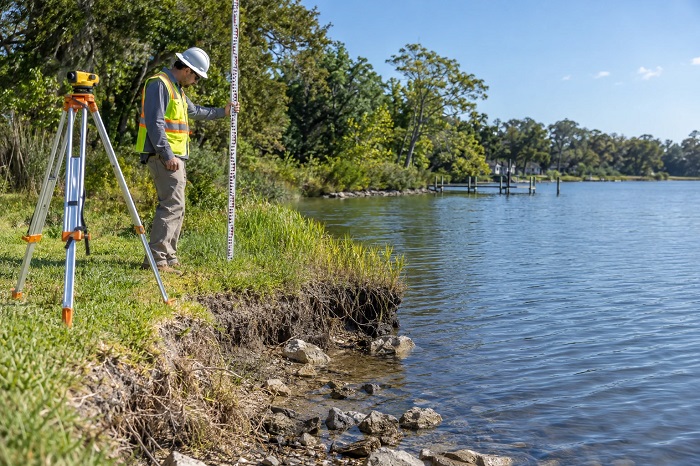
A bulkhead begins as a shoreline problem, not as a material order. Before a wall can be specified, the property has to be read as a combination of soil, water, exposure, access, and intended use. Shore Protect Team lists soil type, water level, and wave load among the conditions it evaluates when planning bulkhead work. Those variables influence the support system, reinforcement, material choice, and construction approach.
Property owners who are still defining the larger waterfront project can start with the company’s Shore Protect Team waterfront services to see how bulkheads fit beside piers, docks, retaining walls, piling, and other shoreline work. A bulkhead assessment is more useful when it is tied to the rest of the property instead of treated as an isolated wall.
The first measurement is not simply shoreline length. The assessment should identify the type of water body, the level changes that occur there, the strength of wave or current exposure, and the soil conditions behind and below the proposed wall. Calm freshwater lakes can require a different solution from tidal zones or open shorelines with stronger wave action.
Access is another site variable because bulkhead construction depends on equipment reaching the work area. The official bulkhead page specifically lists site accessibility as a cost factor and notes that difficult terrain or limited equipment access can increase labor costs. A design that looks straightforward on a drawing can become a different project when machinery cannot approach from land.
The assessment also needs to separate the visible shoreline from the forces acting behind it. Drainage systems are used to prevent groundwater pressure on the structure, while tie-back anchors are used to resist displacement under soil pressure. The number and configuration of these systems depend on the conditions found at the property rather than on a standard package.
Once those conditions are documented, the bulkhead construction choices can be reviewed against the site. The page lists treated wood, vinyl, concrete, riprap, and gabions, together with repair of existing bulkheads. Each option addresses a different combination of exposure, maintenance, drainage, strength, and shoreline character.
Measurements that define the shoreline problem
A useful site review records conditions that affect the wall throughout its full length. Soil type influences pile driving depth and the need for reinforcement. Water level affects where the structure operates relative to the shoreline. Wave load helps distinguish a protected edge from a site exposed to more aggressive water movement.
The point of gathering these measurements is to avoid choosing a material before the forces are understood. A wall that works on a calm lake should not automatically be copied onto an open shoreline. The same principle applies in reverse: a heavily reinforced system may be unnecessary where the site has lower exposure.
- Soil type – Used to determine pile driving depth and whether additional reinforcement is required.
- Water level – Helps define how the wall interacts with the water body during normal and changing conditions.
- Wave load – Indicates whether the shoreline is relatively calm or needs a more substantial response to active water movement.
- Shoreline length – Directly affects material quantity and the overall scope of the work.
- Access – Determines how equipment and crews can reach the construction line from land or water.
- Existing condition – Identifies whether the project is new construction, repair, or replacement of a damaged structure.
Why soil and water should be reviewed together
Soil and water act on different parts of a bulkhead, but the wall must respond to both at the same time. Soft soils can require deeper piles. Groundwater behind the wall can create pressure that drainage is intended to relieve. Soil retained behind the wall can also create forces that tie-back anchors are designed to resist.
This is why a bulkhead should be considered as a system rather than a visible face. The wall material is only one part of the project. Piles, anchors, drainage, caps, connections, and the surrounding soil all affect how the installation is planned.
Turning the assessment into a material decision
The service page connects different bulkhead types with different site conditions. Wood is positioned for calm freshwater lakes and rivers. Vinyl is presented as a low-maintenance option suitable for many water bodies. Concrete is identified for demanding Gulf Coast and hurricane-zone applications. Riprap is associated with aggressive waves and active erosion, while gabions combine rock fill with natural drainage and flexibility.
These descriptions are useful only after the property conditions are known. They do not create a universal ranking. The same owner may reach a different material choice on two properties because the soil, exposure, water body, access, and maintenance priorities are different.
- Document the water body and normal exposure before discussing materials.
- Identify soil conditions and whether the site may require deeper piles or added reinforcement.
- Review groundwater and soil pressure so drainage and anchoring can be planned where needed.
- Confirm how equipment can reach the shoreline and whether access is limited.
- Measure the shoreline length and distinguish new work from repair or replacement.
- Compare bulkhead materials only after the structural and site requirements are clear.
Using the assessment to request a meaningful estimate
A preliminary estimate becomes more useful when it is based on the same site information that will drive construction. Material price per linear foot is only one part of the picture. The final scope can change with water-body type, soil, drainage, anchors, access, shoreline length, and whether the existing structure can be repaired.
A site assessment does not need to produce a material winner before the contractor reviews the property. Its purpose is to define the problem accurately enough that the available bulkhead systems can be compared on the same basis. That produces a clearer project scope and reduces the chance that a proposal is built around an assumption that does not match the shoreline.