







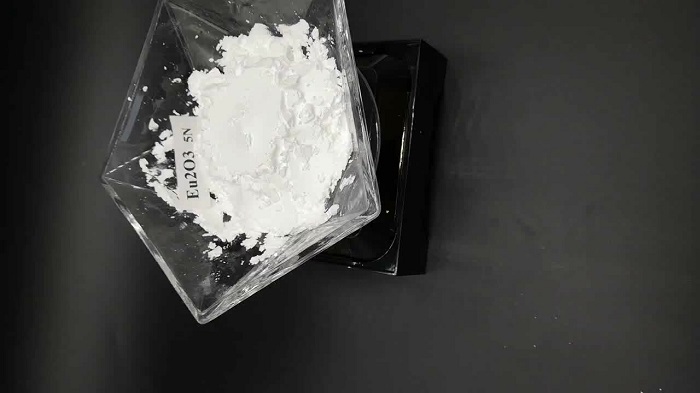
Modern industry makes active use of rare-earth elements and their compounds to manufacture high-tech products. One highly sought-after material in this group is europium oxide—an inorganic compound employed in electronics, optics, the production of phosphors, and the creation of specialized ceramic materials. Its distinct optical and physicochemical properties make it a subject of interest for both scientific research and various industrial sectors.
What is its chemical formula?
Europium oxide is a compound formed by the rare-earth metal europium and oxygen. Its chemical formula is Eu₂O₃. Under standard conditions, it exists as a solid, typically appearing as a white or slightly pinkish powder. The compound is characterized by a high melting point and thermal stability. In this compound, europium is primarily in the +3 oxidation state, which dictates many of the material’s specific chemical behaviors.
One of the primary characteristics of europium oxide is its luminescence. When exposed to an external energy source, europium ions emit light within specific spectral ranges. Of particular importance is the ability of Eu³⁺ compounds to produce an intense red glow. For this reason, europium oxide—along with gadolinium oxide—is widely used as a raw material for the production of specialized phosphors.
Key applications of europium oxide
The most prominent use of Eu₂O₃ is in the production of phosphors for the lighting and electronics industries. Europium compounds are utilized in screen coatings, LED light sources, and other devices that require a stable, saturated red emission. Such materials contribute to high-quality color reproduction and enhance the visual performance of electronic displays.
Another significant application is the manufacture of optical materials. Europium compounds are used in the development of specialized glasses and ceramics engineered with specific, tailored properties. They can serve as active components in materials used for:
- optical devices;
- laser technologies;
- scientific equipment.
Europium oxide is also in demand for the production of functional ceramics and specialized compounds. It is added to certain materials to modify their physical and optical properties. Furthermore, europium compounds and hafnium are being investigated in the development of advanced information storage technologies, photonics, and materials science.